Getting to the Moon, or Mars, or anywhere past them, is only half the problem. The other half is whether the message gets through. Sightlines, relay orbits, and the speed of light decide whether anything you send arrives — and a route that exists is not the same as a route that stays.
Constraint: straight lines onlyMoon: 1.3 light-secondsMars: 3 to 22 minutes
The distance ladder
How far is too far to talk?
Distance does not degrade a link gently. It converts one problem into a different one. Launch four signals at once and watch the gap open — the rail below is logarithmic, so each mark along it is a factor of ten.
At low orbit a command loop closes faster than you can notice. At the Moon it is 2.6 seconds wide, so machines handle the reflexes and people handle the decisions. Past the Moon, "real time" stops existing — and the question changes from how fast the link is to whether there is a link at all.
01 · Line of sight · the nearest hard case
The scarce resource
Radio links do not bend around worlds. In cislunar space, the useful question is often simple: can one antenna see the next one?
The Moon is in synchronous rotation today: one turn per orbit, so the same hemisphere faces Earth. From farside surface sites, Earth stays below the local horizon; a relay is part of the terrain, not an optional upgrade.
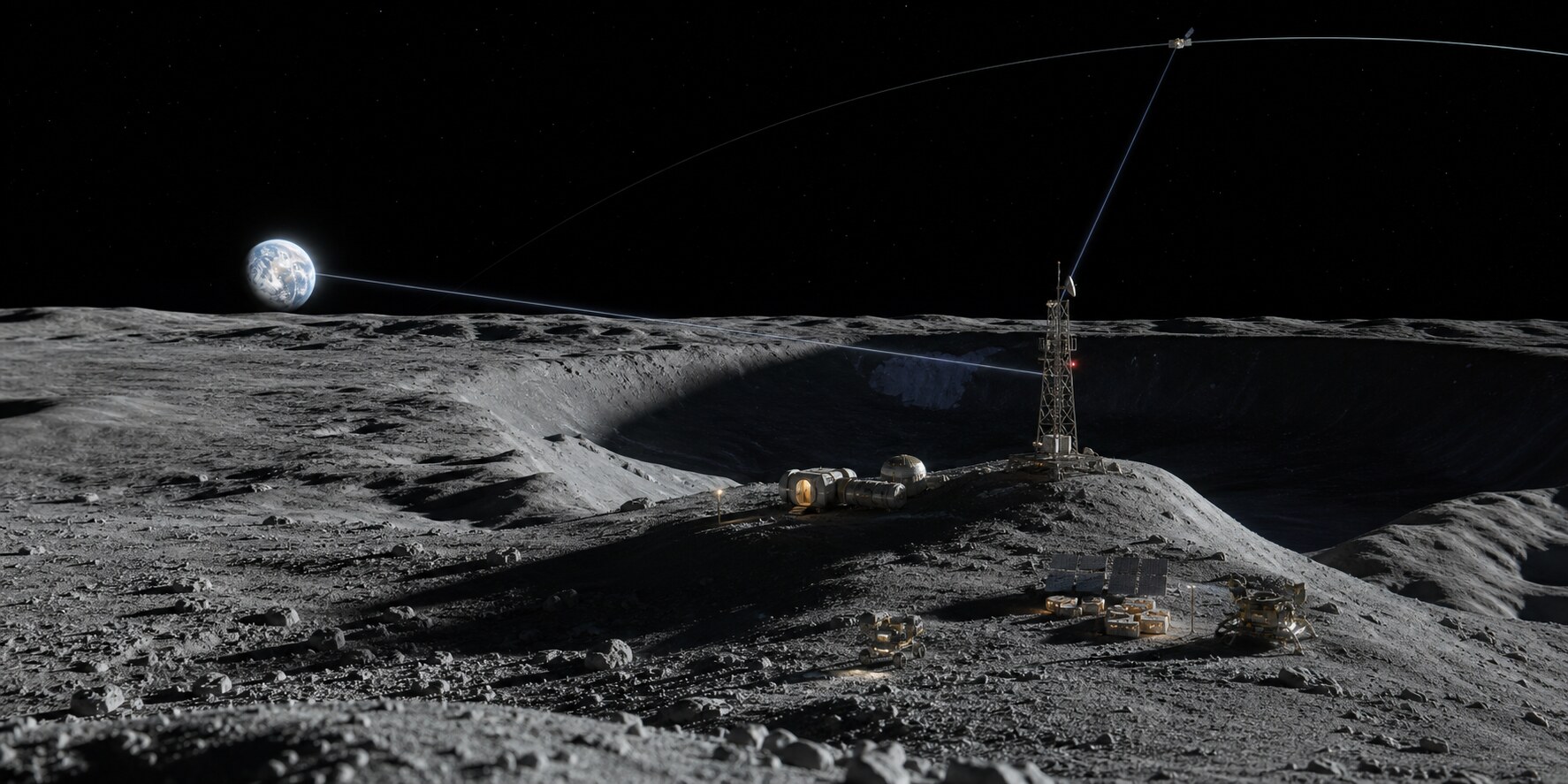
At the poles the problem is subtler. Earth rides low on the horizon, moving only a few degrees with the Moon's slow nod. A crater rim, a ridge, or the wall of a lander can be enough to block the only line home.
Earth link is conditional Tower covers local terrain Relay restores the path
The rover cannot see Earth: the rim is in the way. A tower high enough to clear the rim can reach the rover — but its own Earth link comes and goes. An overhead relay can provide another path when both links have line of sight.
02 · Latency
Even at light speed, you wait
When the line of sight exists, physics still charges rent. A radio pulse covers the 384,400 km from Earth to the Moon in about 1.3 seconds — watch one make the trip below. The round trip is about 2.6 seconds: enough lag that "real time" control is already a stretch.
1.28 sDrawn to scale: the bodies and the gap.
This is why latency, not bandwidth, sets the autonomy budget. On Earth, operators run machines live. At the Moon, every command loop is 2.6 seconds wide, so spacecraft handle the reflexes and people handle the decisions. At Mars, the loop is minutes wide, not seconds.
03 + 04 · Relay geometries
Two blind spots, two different relays
South-pole sites need a relay that dwells above low horizons. Farside sites need one that clears the lunar disc from Earth's point of view.
03 · South-pole dwell
Hold the southern sky
Problem
Low orbiters cross the sky quickly, then drop behind the Moon.
Geometry
An NRHO climbs high over the south pole and moves slowest there.
What it buys
Long dwell, Earth view, and a useful sky position for polar assets.
day 3.3 of 6.56south-pole link: holdinglow orbiter: in viewDistances compressed; the low orbit is shown slower than reality — its real contact windows are even briefer.
Why this orbit helps
Near-rectilinear halo orbits belong to the halo families around the Earth-Moon balance points. The Gateway reference orbit swings within about 3,000 km of the north pole, then climbs to roughly 70,000 km above the south pole. Because orbital motion is slowest near that high point, the relay spends much of each 6.5-day lap in the part of the sky a south-pole site can use. Gateway itself was paused in March 2026; the orbit family stands on its own as relay geometry.
04 · Farside relay
Step off the shadow line
Problem
The Moon sits between a farside surface site and Earth.
Geometry
A relay loops around L2 instead of sitting on the centerline.
What it buys
Simultaneous visibility to Earth and the farside surface.
The relay orbits the balance point instead of sitting on it. Seen from Earth, the halo loop clears the Moon's disc while still seeing the farside surface.
This is flown hardware, not a thought experiment. China's Queqiao relay has worked from a halo orbit around L2 since 2018, supporting the Chang'e-4 farside mission.
Distances compressed, geometry faithful.
05 · The corridor
Assemble the corridor
Turn the layers on and the route stops looking like one radio hop. It becomes a stitched path: ground antennas, relay orbits, local surface links, and a store-and-forward network that waits for the next scheduled contact.
End-to-end pathAll layers active
bundlewaiting for the first contact
In the coverage scenario behind this storyboard, one relay in a halo orbit around L2 removed the low-orbiter geometry gaps: the worst daily gap went from 21 minutes to zero. Three conventional relay satellites were needed to match that result.
How a network with breaks still delivers
Networks like this do not route the way the internet does. Link schedules are computed ahead of time from orbital geometry — a contact plan — and traffic waits out gaps onboard instead of being dropped. A message may ride a relay for twenty minutes before its next link rises.
Go further
Fly the geometry yourself
The orrery is a small flyable solar system — the same orbital mechanics that shape the corridor, at full scale. WASD to fly, click a body to focus.
TIN, the Tolerant Interplanetary Network project, built and tested the routing layer this page sketches: contact plans computed from geometry, store-and-forward custody, delivery decided by schedule rather than luck. Main development is on pause while the mathematics takes the foreground. The public code, papers, and reproducibility baselines remain available.
Alongside the code sits a conformance question: replay a network's frozen schedule — do the delivered outcomes stay within preregistered statistical bounds? A white paper answers with certificates carrying explicit radii, not point estimates.
The newer mathematics follows connectivity into a different setting: the gaps between packed spheres, their tunnels, and their changing topology. Alongside it sits a series on positivity inequalities and sharp constants.
The animated network is an illustration of connectivity; it does not model a space mission. The lunar scene and relay diagrams are notional. The factual anchors are narrower: lunar geometry, light-time, the published Gateway orbit, and the flown Queqiao relay.
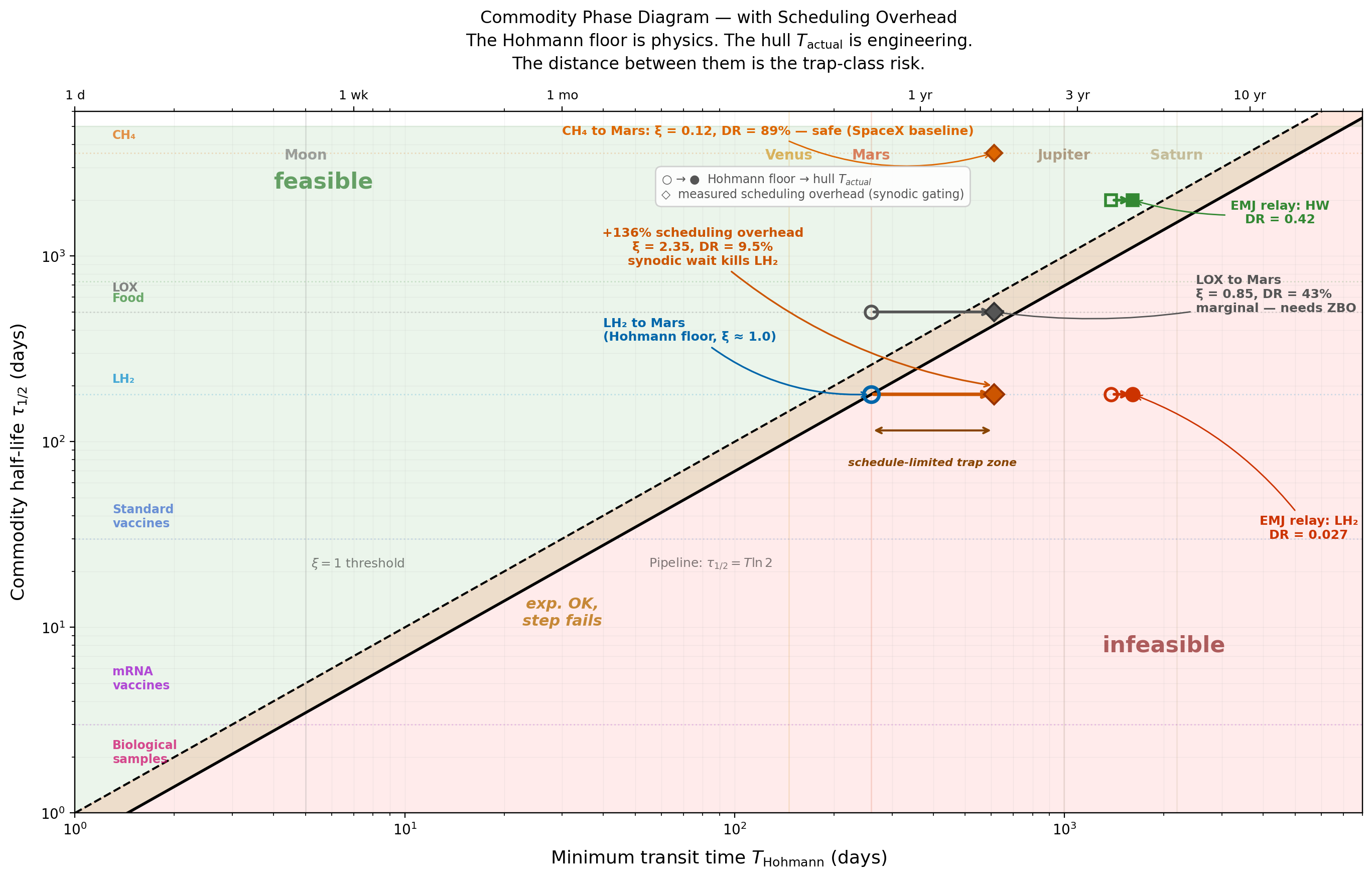
The older propellant result is still the broader logistics frame. Before cargo becomes interplanetary, the Earth–Moon system has to be observable, commandable, and recoverable.